Dreamcast
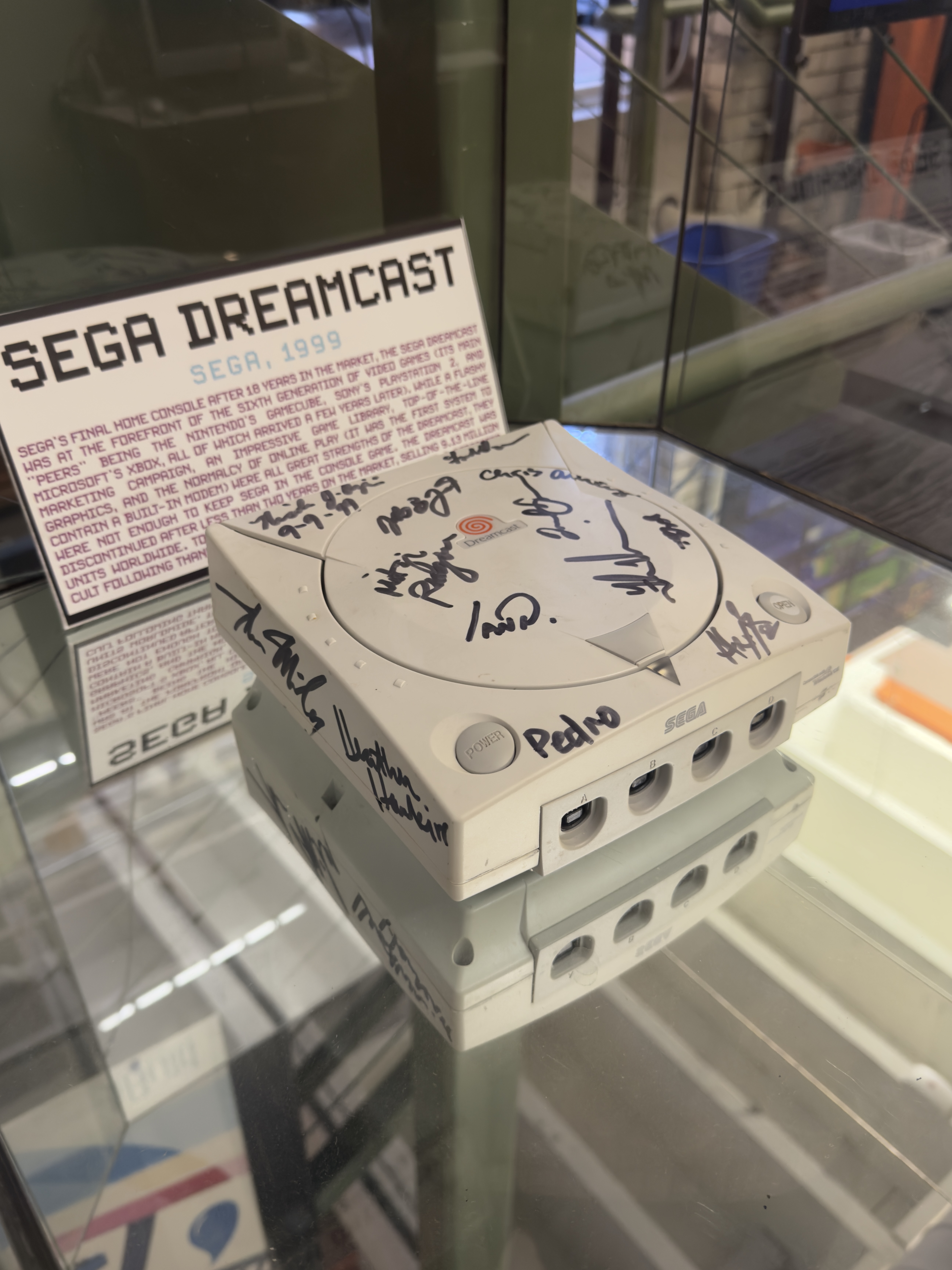
When you think of the Sega Dreamcast, you might think of Sonic's first 3D game, Sonic Adventure, or the first entry to the Soulcalibur series, or the iconic soundtrack of Crazy Taxi.
The Dreamcast pushed the frontier of gaming forward while also serving up familiar arcade experiences at home. Games like Virtua Tennis and Marvel vs. Capcom 2 were flawlessly ported onto the Dreamcast from the arcade thanks to the Sega NAOMI, a special arcade system board shared between Sega Arcade cabinets and the Dreamcast [1]. However, the Dreamcast could do a lot more than that. It used some of the most advanced graphics and computing cards available at the time, boasting a massive 480p resolution! (That's about 1/8 the resolution of a 4k TV.) This demonstration of Sega President Shoichiro Irimajima's head showed off how the console handled light sourcing, alpha blending, and environment mapping, not just in cinematics but during actual gameplay! (Not to mention Sega's sense of humor) [2].
The advanced hardware enabled a shared aesthetic for many Dreamcast games, sometimes called “Sega Blue Sky” [3]. Games like Space Channel 5 and Jet Set Radio exemplify this style: vibrant, dance-worthy, and optimistic.
It was the first console with a built-in modem which meant you could play online games like Phantasy Star Online right out of the box.[cite] Sega made sure that developing for the Dreamcast was as effortless as possible with a Windows CE-based OS [2]. This meant it was easy to experiment with game design as you'll see in titles like Shenmue and Seaman, which pushed the boundaries of what gameplay could be.
The Dreamcast's launch was a huge success, especially in North America with the famous “It's Thinking” ad campaign. Over half a million consoles were sold in the first two weeks alone. It took the original Playstation months to hit that milestone. [4].
Unfortunately, this success was short lived. The Playstation 2 was released in October 2000, just over a year after the Dreamcast was released in North America. As anticipation for Sony's new console grew, interest in the Sega Dreamcast quickly waned. When the Dreamcast failed to hit it's sales targets and Sega began losing money, the company decided to pivot away from hardware. Today, Sega remains one of the most influential game studio and publishing companies, though they have never made another console. The spirit of the Dreamcast lives on, however, with the in-game arcade cabinets you'll find within Like a Dragon: Infinite Wealth, where you can catch a quick game of Sega Bass Fishing. Or you could grab a Dreamcast controller and go fishing here at the MADE.
Specifications | |
|---|---|
Codename | Katana |
CPU | Hitachi SH-4 @ 200 MHz |
Memory | 16 MB RAM, 8 MB video RAM, 2 MB audio RAM |
Graphics | NEC PowerVR2 @ 100 MHz |
Display | Composite /RM modulator / SCART/ S-video / VGA (w/ adapter) |
Sound | Yamaha AICA @ 67 MHz with ARM7 CPU, 64 channels |
Connectivity | Modem, broadband (w/ adapter) |
Retail Information | |
|---|---|
Original 1999 Price | $199 USD |
2026 Adjusted Price | $400 USD |
Units Sold | 9.13 Million |
References
[1] “IGN Presents the history of Dreamcast”. Fahs, Travis. IGN. Published 2010, September 9. Updated 2017, August 1. Accessed 2026, March 24. https://www.ign.com/articles/2010/09/10/ign-presents-the-history-of-dreamcast.
[2] “Impressions of Sega's Dreamcast Presentation”. Ohbuchi, Yutaka. Gamespot. Published 2012, February 1. Accessed 2026, March 24. https://www.gamespot.com/articles/impressions-of-segas-dreamcast-presentation/1100-2463809/.
[3] “What are Sega Blue Skies?” UtterSpartan. YouTube. Published 2022, November 6. Accessed 2026, March 24. https://www.youtube.com/watch?v=dJFwNQqMtlw.
[4] “The Rise and Fall of the Dreamcast” Perry, Douglas C. Game Developer. Published 2009, September 8. Accessed 2026, March 24. https://www.gamedeveloper.com/business/the-rise-and-fall-of-the-dreamcast.